ESP-WROOM-32
CH340 USB-to-Serial Driver
We transitioned from Arduino to the ESP-WROOM-32 to handle complex real-time telemetry. Its dual-core architecture allows us to read sensors on one core while maintaining a stable 4G data connection on the other. The onboard CH340 chip provides reliable USB-to-serial communication for programming and debugging.
Bill of Materials
Complete component list for the ChitoNet buoy system
| Component Name | Spec/Model | Qty | Function |
|---|---|---|---|
| ESP32 Dev Board | ESP-WROOM-32 (CH340) | 1 | Main Controller |
| Temperature Probe | DS18B20 (Waterproof) | 1 | Water Temp |
| pH Sensor Kit | Analog Output | 1 | Acidity Level |
| Turbidity Sensor | Analog Optical | 1 | Water Clarity (NTU) |
| DO Sensor | Analog Output | 1 | Dissolved Oxygen |
| Relay Module | 24V / 10A | 2 | Drive Actuator/Aerator |
| Linear Actuator | 24V DC | 1 | Chitosan Packet Deployment |
| Battery Pack | 24V Rechargeable | 1 | Main Power Supply |
| Consumables | |||
| Chitosan Powder | 85% Deacetylation | — | Active Treatment Agent |
| Bentonite Clay | Natural Clay | — | Binding & Sinking Agent |
| Wafer Paper | Water-Soluble | — | Packet Wrapping |
Power Budget Analysis
Calculated load for the 3.3V rail. The ESP32's onboard regulator typically handles ~600mA.
Assembly Checklist
-
1Breadboard Rails Use the top rail for 3V3 and bottom rail for GND to prevent accidental shorts.
-
2Voltage Extension Board An extension board handles voltage level shifting between the 3.3V ESP32 and the 24V actuator/aerator system — no external resistors needed.
-
3Sensor Partitioning Keep analog sensors (pH, Turbidity, DO) on the left side of the board and digital/noisy components (Relays) on the far right.
Complete Wiring Pinout
Detailed pin connections for all sensors and components
| ESP32 Pin | Device | Wire Color | Notes |
|---|---|---|---|
| 3V3 | DS18B20 Temp VCC | Red | 3.3V power (temp sensor only) |
| 5V (VIN) | pH / Turbidity / DO VCC | Red | 5V power via extension board |
| GND | Common Ground | Black | Must connect 24V battery (-) here too |
| GPIO 15 | DS18B20 Temp | Yellow | Digital 1-Wire (via extension board) |
| GPIO 34 | pH Sensor PO | Blue | Analog Input Only |
| GPIO 35 | Turbidity OUT | Blue/Yel | Analog Input Only |
| GPIO 32 | DO Sensor OUT | Cyan | Analog Input Only |
Sensor Array
Four critical sensors working together to monitor water quality
pH Sensor
Measures the acidity or alkalinity of water on a scale from 0 to 14. Critical for detecting chemical imbalances that can lead to eutrophication.
Specifications
- Range: 0-14 pH
- Accuracy: ±0.1 pH
- Response Time: < 1 minute
- Interface: Analog output
- Operating Temp: 0-60°C
DS18B20 Temperature
Waterproof digital temperature sensor that provides accurate water temperature readings. Temperature changes can accelerate nutrient absorption and algal growth.
Specifications
- Range: -55°C to +125°C
- Accuracy: ±0.5°C
- Resolution: 9-12 bit selectable
- Interface: One-Wire digital
- Waterproof: IP68 rated
Turbidity Sensor
Optical sensor that measures suspended particles and water clarity in NTU (Nephelometric Turbidity Units). High turbidity indicates sediment, algae, or organic matter.
Specifications
- Range: 0-1000 NTU
- Accuracy: ±5%
- Method: Optical nephelometry
- Interface: Analog output
- Response Time: < 500ms
Dissolved Oxygen
Measures oxygen concentration in water, critical for detecting hypoxic conditions caused by eutrophication and algal blooms.
Specifications
- Range: 0-20 mg/L
- Accuracy: ±0.2 mg/L
- Type: Electrochemical galvanic cell
- Response: < 60 seconds
- Interface: Analog output
Treatment System
Chitosan Aerator & Dispenser
Automated treatment system for preventing and controlling algal blooms
💧 Chitosan Packet Launcher
Chitosan powder is mixed with bentonite clay and wrapped in water-soluble wafer paper to form compact, dissolvable packets. A relay-controlled 24V linear actuator launches these packets into the water when eutrophication risk is detected. Once submerged, the wafer paper dissolves and the chitosan–bentonite mixture disperses to flocculate algae and bind excess nutrients.
Key Features
- Mechanism: 24V linear actuator launches pre-made packets
- Wrapping: Water-soluble wafer paper — dissolves on contact with water
- Payload: Chitosan (85% deacetylation) + bentonite clay
- Control: Relay-driven, triggered by ESP32 based on ML predictions
- Effectiveness: Removes 70-90% of algae within 24 hours
🌀 Micro-Aerator System
Integrated micro-aerator improves chitosan dispersion and increases dissolved oxygen levels in water, creating unfavorable conditions for algal growth while supporting aquatic life.
Specifications
- Type: Submersible micro-bubble aerator
- Air Flow: 2-5 L/min adjustable
- Power: 24V DC pump (relay-controlled)
- Bubble Size: 0.5-2mm for optimal oxygen transfer
- Operation: Intermittent or continuous mode
How Chitosan + Bentonite Remove Excess Algae Cells
After the wafer paper dissolves, the chitosan–bentonite mixture disperses through the water and rapidly forms larger aggregates that capture suspended algae cells. These heavier flocs settle out of the water column, reducing visible bloom density and helping restore clarity.
Chitosan is a cationic biopolymer that attracts and binds to negatively charged algae cell surfaces, helping destabilize suspended cells.
Polymer “bridging” links many cells into larger flocs, making the algae easier to separate from the water.
Bentonite clay adds mass and adsorption surface area, helping flocs sink and reducing the nutrients available for continued algal growth.
How It Works
Detection
ML model predicts high eutrophication risk
Activation
ESP32 activates relays to drive actuator and aerator
Treatment
Wafer paper dissolves, chitosan–bentonite flocculates algae; aerator adds oxygen
Monitoring
Sensors track water quality improvement
Intelligent Analytics
Machine Learning Prediction System
Advanced AI-powered eutrophication risk prediction using Gradient Boosting algorithms
🧠 Predictive Model
ChitoNet employs a sophisticated Gradient Boosting machine learning model trained on high-quality environmental datasets to predict chlorophyll-a levels—the primary indicator of eutrophication risk.
Model Performance
- Algorithm: Gradient Boosting Regressor
- Target Accuracy: R² > 0.90
- Input Features: pH, Temperature, Turbidity, Dissolved Oxygen
- Output: Chlorophyll-a concentration prediction
📊 Data Processing Pipeline
Real-time Sensor Data Collection
ESP32 collects pH, temperature, turbidity, and dissolved oxygen readings every minute
Cloud Transmission
Data sent to ThingSpeak platform via 4G for storage and processing
ML Model Inference
Gradient Boosting model predicts chlorophyll-a levels and eutrophication risk
Alert & Visualization
Dashboard displays predictions and triggers alerts when thresholds are exceeded
Scientific Foundation
Our model is trained on high-quality monitoring data from 国控站水质数据 (The Chinese National Control Station Water Quality Data), and continuously learns from new samples to improve prediction accuracy and adapt to local water conditions.
System Architecture
Buoy Deployment
Each ChitoNet buoy is a self-contained monitoring unit designed for long-term deployment in aquatic environments. The buoys are strategically positioned across large water areas, forming a comprehensive monitoring network.
🔋 Power System
24V rechargeable battery with solar charging support for 24/7 operation. Designed for extended deployment periods.
📡 Data Transmission
4G cellular connectivity enables real-time data transmission to ThingSpeak cloud platform for analysis and monitoring.
🌊 Waterproof Housing
IP68-rated enclosure protects all electronics from water, ensuring reliable operation in harsh aquatic environments.
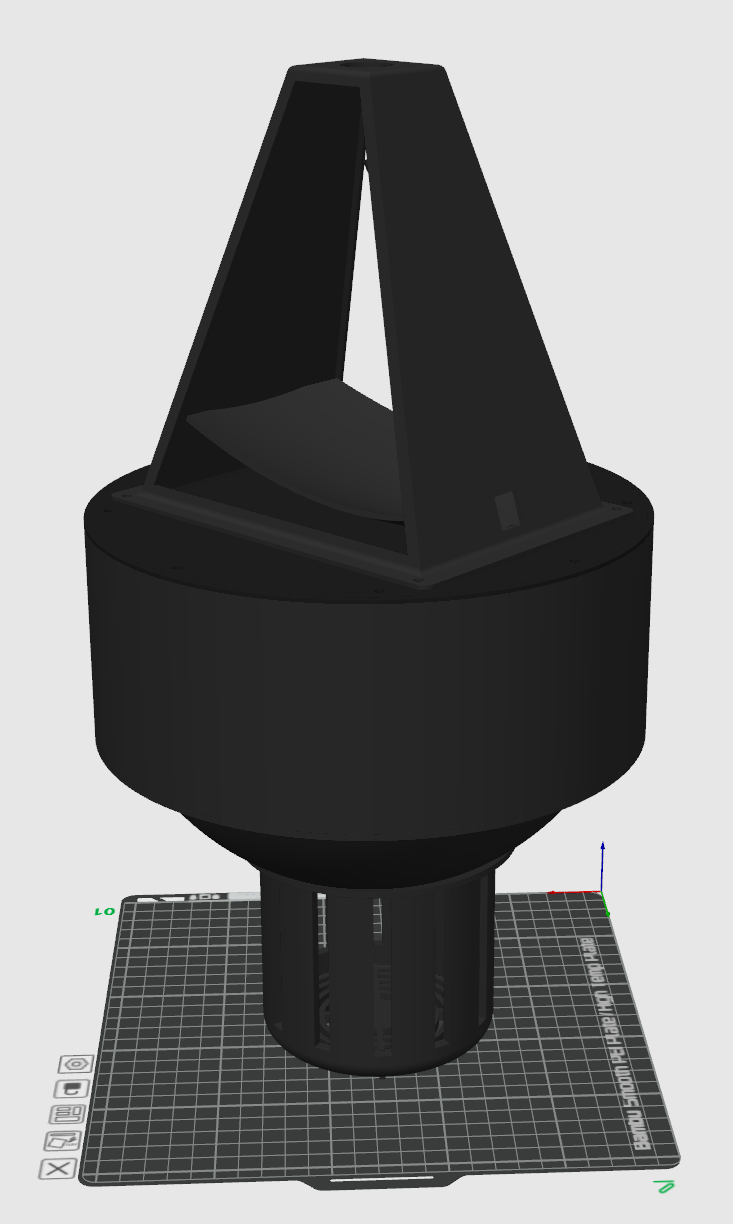
📐 3D Buoy Enclosure & Materials
The buoy body and upper tower are designed as a 3D-modeled assembly, inspired by the reference buoy form factor, and will be manufactured using UV-stabilized polyethylene (PE) to withstand long-term outdoor exposure and intense sunlight.
Data Flow
Sensor Data Collection
ESP32 reads data from pH, temperature, turbidity, and dissolved oxygen sensors
Data Processing
ESP32 processes and formats sensor readings
4G Transmission
Data sent wirelessly to ThingSpeak cloud platform via 4G cellular
Cloud Storage & Analysis
Data stored and analyzed in real-time on ThingSpeak
Dashboard Display
Users access real-time data through ChitoNet web dashboard
3D Buoy Enclosure
The ChitoNet buoy enclosure is modeled as a full 3D assembly, including the lower float body, central sensor column, and tapered tower for mounting solar panels and communication hardware.
The final enclosure will be manufactured using UV-stabilized polyethylene (PE) so it can withstand long-term sun exposure, waves, and outdoor conditions without becoming brittle or discolored.
This render represents the current buoy concept used for mechanical design, sensor placement, and mounting clearances.
Wiring & Connections
Clear wiring blocks for fast assembly and troubleshooting
Sensor Connections
pH Sensor
- VCC: 5V
- GND: GND
- Signal: GPIO 34 (Analog)
DS18B20 Temperature
- VCC: 3.3V
- GND: GND
- Data: GPIO 15 (via extension board)
Turbidity Sensor
- VCC: 5V
- GND: GND
- Signal: GPIO 35 (Analog)
Dissolved Oxygen Sensor
- VCC: 5V
- GND: GND
- Signal: GPIO 32 (Analog)
Power Requirements
-
⚡
Main Battery: 24V Rechargeable
Powers actuator and aerator via relays. ESP32 powered through voltage regulator.
-
🔋
ESP32 Logic: 3.3V (regulated from 24V supply)
Onboard CH340 for USB programming; 5V sensors powered via extension board
-
☀️
Solar Power: Solar panels to charge the 24V battery
The buoy uses solar panels to keep the 24V battery charged during long-term deployment.
Network Deployment Strategy
Strategic Placement
Buoys are positioned across large water areas to provide comprehensive coverage and detect localized issues.
Continuous Monitoring
24/7 data collection ensures early detection of water quality changes before they become critical.
Network Coverage
Multiple buoys work together, providing spatial data about water quality variations across different zones.